Watch the full video at the end.
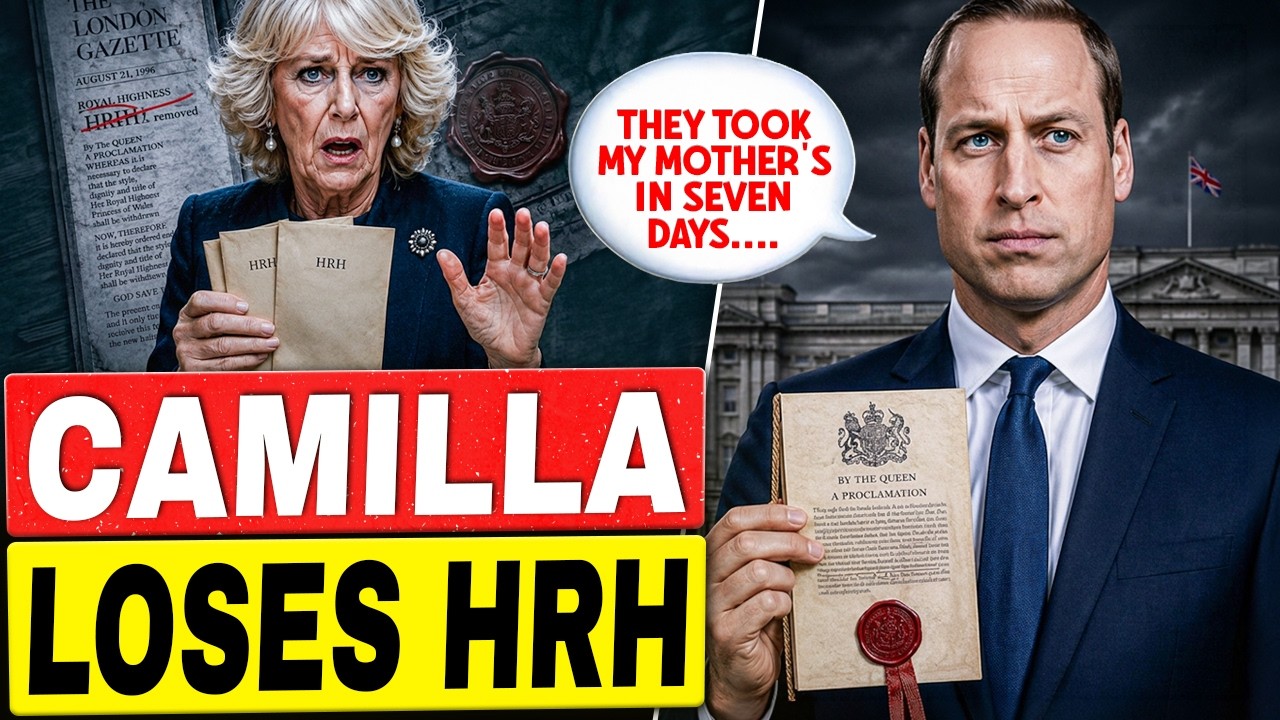
A video essay examines 15 royal letters patent and related documents that, in its telling, form the “paper machinery” controlling who is styled “Royal Highness.” The essay argues that when King Charles dies, Camilla would lose the letters HRH, and that Diana’s son, now heir to the throne, would inherit the power to alter that title, including possibly restoring Diana’s HRH as a posthumous “correction.”
Royal titles, it says, are not fixed by nature or ordinary law but by pieces of paper signed by the monarch under the royal prerogative. The same instrument class that took Diana’s HRH in 1996 could be used in reverse, and the real question, the essay argues, is who holds the pen when Charles dies.
The essay also points to an 11-day window between a monarch’s death and funeral â first tested in September 2022 â during which a new king could act before the funeral. It concedes that its larger argument is interpretation rather than confirmed reporting.
The dates themselves are not in dispute. Letters patent are among the oldest instruments of royal government, printed in the London Gazette and held in the public records, and the Queen’s death turned public attention to them in a way few royal documents ever receive.
A public that had rarely thought about succession law watched an Accession Council meet, heard proclamations read in the City, and saw the new King’s cypher begin appearing on official lettering. The video belongs to a wave of royal constitutional commentary that has grown since then, one built on archives rather than gossip.
The first document, dated November 30, 1917, is what the video calls the “paper fence.” George V issued letters patent defining who carried the style: the sovereign’s children, children of the sovereign’s sons, and one designated grandson.
The 1917 instrument came out of a war with Germany; the previous July, George V had changed the family name from Saxe-Coburg and Gotha to Windsor and shed German titles. The letters patent tightened the circle of royal persons to stop the style expanding indefinitely, and the video’s point is that the line one man drew was later redrawn.
The second document, dated May 27, 1937, is the “same page clause.” Edward VIII was created Duke of Windsor and kept HRH, but the same page denied HRH to his wife, Wallis Simpson, and any descendants.
Edward had abdicated in December 1936, and the letters patent were issued weeks before his wedding to Wallis in June 1937; she never held the style for a day, and for the roughly 35 years until the Duke’s death she watched rooms curtsy to her husband but not to her. The video calls this the crucial precedent: once a monarch has excluded a wife from HRH, the same can be done again, with no appeal, no court, and no vote.
The third instrument, dated October 22, 1948, is what the video calls “the pen pointed back.” George VI issued letters patent so Princess Elizabeth’s children would be born with HRH, even though the 1917 rules would not have qualified them.
Elizabeth was a daughter, and the 1917 rules ran through sons, so the new instrument, issued weeks before Charles was born in November 1948, pulled an heir inside the fence. The same logic was used in December 2012, when the Queen issued letters patent so that every child of the Duke and Duchess of Cambridge would be born an HRH; without it, the rules would have left the younger children outside.
The fourth item is what the video calls the “7-day removal”: the letters patent of August 21, 1996. They declared that a divorced wife of a British prince loses HRH, and the decree absolute followed a week later.
The divorce had taken years to reach that point. The couple separated in 1992, and after Diana’s Panorama interview in 1995 the Queen was widely reported to have written to both parties urging an early divorce.
Terms were agreed the following year, and the decree absolute was issued on August 28, 1996. From that day, Diana became Diana, Princess of Wales, keeping the title but losing the style, and with it the definite article.

The video says the letters patent were signed with Diana’s name on them and printed in the London Gazette that week. The House of Commons library, according to the video, records the change in one line: “Conferred by letters patent, removed by the same instrument.”
The removal was accomplished without court, vote, or her consent, and the narrator stresses how quickly the country absorbed what had happened. Sympathetic press reports at the time said Diana was wounded by the condition, but there was no appeal.
The speed matters to the essay’s argument: the demotion of the most famous woman in the world was complete in a week, not because anyone accepted it, but because the paper allowed no argument. An instrument that can withhold a style can create one, which is the bridge to the rest of the sequence.
The fifth item is what the video calls “the broken promise.” On February 10, 2005, Clarence House announced that Camilla would be styled HRH The Duchess of Cornwall and would become “Princess Consort,” not Queen, when Charles succeeded.
The announcement was engineered for a skeptical public; polls at the time still showed a majority opposed to the remarriage, and the Queen did not attend the civil ceremony at Windsor Guildhall. The promise of a lesser title was part of the price of acceptance, and the video says it was quietly set aside in later years.
The sixth item is “the title she never touched.” On April 9, 2005, Camilla married Charles and in law automatically became Princess of Wales, but she never used the title because of public feeling about Diana.
In Scotland, where her husband is styled Duke of Rothesay, she is Duchess of Rothesay instead; the essay dates the shelving of the legal title at 18 years. The seventh item is “the sincere wish.”
On February 5, 2022, Elizabeth II issued a message saying it was her “sincere wish” that Camilla be known as Queen Consort when Charles succeeded. The message marked the Queen’s Platinum Jubilee, and it dissolved the 2005 compromise in a sentence.
The video stresses that this was not an act of Parliament and not a change in law. The eighth item is “the vanishing word.”
On May 6, 2023, Camilla was crowned beside Charles at Westminster Abbey. Official material â the palace’s own communications before the coronation and government statements after it â began referring to “Queen Camilla,” with the qualifier “Consort” disappearing by usage rather than by sealed instrument.
The ninth item is what the video calls “the first hour, honestly.” Accession is instantaneous: the moment Elizabeth died on September 8, 2022, Charles was king and William became heir in the same second, though sealed documents take a working day or two.

Two days later, the Accession Council proclaimed the King in a ceremony that was itself an exercise in paperwork. The tenth item is the “11-day window.”
Elizabeth died on September 8, and her funeral was September 19. Between those dates Charles gave a televised address, held his first audience with the prime minister, traveled to Scotland, Northern Ireland, and Wales, and addressed Parliament at Westminster Hall.
Around 250,000 people filed past the coffin during the lying in state, and hundreds of world leaders attended the funeral. The video’s point is that a new sovereign already acts inside that window, so the same window could be used before a future funeral if a king chose to move.
The eleventh item is what the video calls “the hand that signs.” In December 2022, Parliament widened the Counsellors of State Act to add Princess Anne and Prince Edward as possible acting sovereigns.
Ministers argued the existing pool was too thin because two eligible names had withdrawn from public duties, and the video raises the question of who might sign a future instrument when the throne changes hands. The twelfth item is the Crown Office, what the video calls “where paper becomes real.”
Letters patent are prepared there and sealed as instruments of the royal prerogative, and the narrative says it took only a clerk’s minutes in August 1996 to end Diana’s HRH. The thirteenth item is the London Gazette, what the video calls “the public record.”
The Gazette has been the state’s official newspaper since 1665, and letters patent are printed there so the change binds the public record. The video says the 1996 entry on Diana is about four lines of unemotional civil-service text and has never been amended.
The fourteenth item is “the statute wall.” HRH styles sit under the prerogative and can be moved by a sovereign alone in days, while peerages sit in statute and removing one requires Parliament.
The contrast is visible elsewhere: when the succession rules themselves were modernized in 2013, ending male preference primogeniture, Parliament had to pass a statute. The video’s conclusion from the wall is pointed: the law protects Camilla’s dukedoms but not her letters.

The fifteenth item is “the correction.” The video says it cannot be a literal return because Diana is dead.
It would be a correction of official records, memorials, and the gazette â withdrawing the institution’s written judgment about her. The essay frames that as a question of memory as much as law.
The BBC’s later acknowledgment that the Panorama interview was obtained by deception, and William’s public response calling the programme illegitimate, have kept the institution’s treatment of Diana in front of a new generation. William, the video notes, has never once said he will restore Diana’s HRH, and has never once said he will not.
It treats that silence as part of the story. The essay argues that one virtue could make all 15 instruments worthless: restraint.
If William chooses restraint, the machinery stays dormant and Diana’s record remains as it was written. No palace or government source has confirmed that a posthumous restoration of Diana’s style is legally possible.
The video’s final promise is a separate accounting of what changes for Camilla’s homes, jewels, and seats on the day Charles dies. Whatever one makes of the argument, the dates are verifiable and the documents are public.
Every reign produces its own paperwork, and this one has already rewritten parts of the system â the counsellors, the coronation, the style of the Queen. The question of who holds the pen is not going away.
Full video.